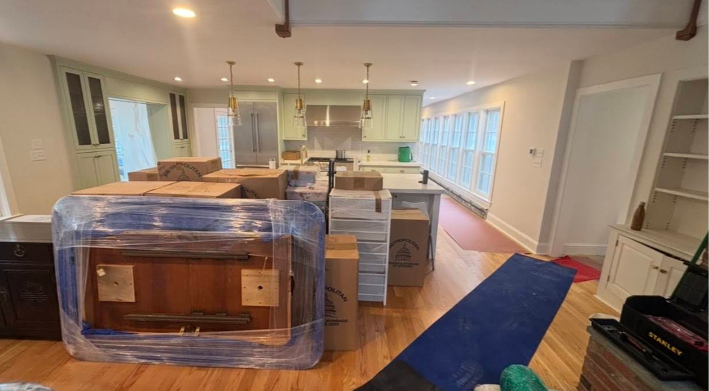
Packing room by room beats packing by category, because a box that holds one room unpacks into one room. The method matters less than the consistency. Each room gets its own boxes, its own label, and materials matched to what is actually inside it. We pack homes across New Hampshire every week, and the difference between a smooth unload and a frustrating one usually comes down to whether the boxes were built around rooms or around whatever was nearest at the time.
Start with the Rooms You Use Least
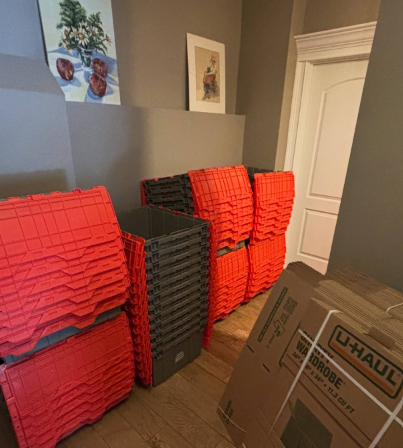
The order is not arbitrary. Rooms you barely touch can be packed weeks ahead without disrupting daily life, which means the pressure never concentrates into the final 48 hours. Guest rooms, basements, attics, formal dining rooms, and seasonal storage all qualify. The full sequence mapped against a calendar is laid out in an eight-week moving timeline.
Leaving the kitchen and the primary bedroom until last is deliberate. Those rooms stay functional until the end, and packing them early means living out of boxes for a fortnight. Working from least used to most used also builds skill on low-stakes items. A crew member learning to pack efficiently does not start on a china cabinet, and neither should you.
Kitchens Take the Longest, So Budget for It
The kitchen is consistently the slowest room in a house, and homeowners underestimate it more than any other. Dishes, glassware, small appliances, a pantry, and a drawer of utensils that defies categorization all live in one space. A kitchen that looks like an afternoon regularly turns into a full day.
Dish packs exist for a reason. They are double-walled and sized for plates stacked on edge, which is how plates survive a truck. Plates laid flat crack under their own weight once something shifts. Glasses and stemware go upright with paper inside the bowl and nothing stacked above them. Small appliances travel best in their original boxes when those survived, and in a snug carton with padding on all six sides when they did not.
Write the room name on four sides of every kitchen box rather than just the top. Kitchens generate the most boxes in the house, and a stack of unmarked cartons in a new kitchen is the single most common unpacking complaint we hear.
Bedrooms, Closets and the Wardrobe Box Shortcut
Bedrooms are the fastest rooms in most homes once the closets are handled properly. The furniture is straightforward, the drawers can often stay loaded for a local move, and the real time sink is clothing. Wardrobe boxes solve most of that. Hanging clothes transfer straight from a rod into the box and straight back out at the other end, which removes folding, refolding, and ironing from the process entirely.
Shoes, handbags and folded items fill the bottom of a wardrobe box, which is otherwise wasted space. Linens and bedding make excellent padding inside other boxes rather than occupying cartons of their own. Mattresses need covers, especially on a long-distance move or anything traveling through a New Hampshire winter. Bed frames come apart, and hardware goes into a labeled bag taped to the frame itself. We include furniture disassembly and reassembly for beds and tables at no extra charge, so the frame itself is one job you can leave to the crew.
Would rather hand over the kitchen and anything breakable? Give us a call at (603) 288-9627, and we’ll tell you honestly which rooms are worth handing over and which ones you can keep for yourself.
Bathrooms, Living Rooms and Everything Breakable
Bathrooms are small and deceptively slow. Liquids leak, so anything open gets a layer of plastic under the cap before the lid goes back on. Medication travels with you rather than in the truck. A single clearly marked box holding a shower curtain, towels, soap and toilet paper for each bathroom is worth building deliberately, because it is the first thing anyone needs in a new house.
Living rooms are where the fragile and the awkward collect. Televisions ride best in their original cartons, screen protected and upright. Lamps break down into base, shade, and bulb, each wrapped separately. Framed art and mirrors need corner protection and a rigid box rather than a blanket alone. Books go into small cartons, never large ones, because a large box of books weighs more than anyone expects and the bottom fails at the worst moment. Electronics benefit from a photograph of the cable layout before anything is unplugged.
Garages, Sheds and the Room That Takes Two Passes
Garages need a sorting pass before a packing pass, and treating them as one job is why they overrun. Tools, sports equipment, paint, lawn chemicals, bikes and a decade of accumulated hardware rarely sort themselves into boxes without a decision stage first. Most households find a meaningful share of a garage does not need to move at all.
The second reason garages run long is that a portion of the contents cannot legally go on a truck. Fuel, propane, aerosols, pool chemicals, and paint all stay behind, and finding that out on move day creates a scramble. Tools travel well in small sturdy cartons or in their own chests. Loose hardware goes into sealed bags inside a single labeled box. Sharp tools get the blade wrapped and taped before anything else touches them. Garden equipment with a fuel tank needs that tank drained well in advance, which is a job for the week before, not the morning of.
Where This Leaves Your Move Day
Packing room by room does not make packing fast. It makes unpacking fast, and it makes the load predictable for the crew moving it. Boxes built around rooms get staged around rooms at the other end, which is the difference between a house you can live in by evening and a house you are still sorting on Thursday.
Request a free quote whenever you have a move date in mind. Call (603) 288-9627 or email info@eammoving.com to talk through a move in Manchester, NH, or anywhere else in the state. We’re open seven days a week, 7 AM to 9 PM, and you can contact us anytime. We’re happy to walk through whatever’s on your list.
Related Topics:
Ready to plan your move?
Get a free, no-obligation quote from a real person — usually within the same business day.
 Book Now